Front Gardens are valuable resources for the shared landscape of the street if landscape potential is maximised:
Elements such as vegetable growing and seating ensure regular use of the garden by the house owner providing contact with neighbours and passers by.
A simple bench can be positioned, semi screened by plants from the street giving choice of highly social or less social interactions.
Exclusion of cars allows space for more planting but if car parking can’t be avoided, this should be ideally be on a gravel /pebble surface with emergent low planting reducing use of hard materials such as block pavers and tarmac. Exuberant planting will also reduce the visual scale of the vehicle.
Some paved areas may be required for access which doesn’t have to be a straight line to the front door but with asymmetric balance could provide more of a varied journey.
Varied heights, shapes, forms and textures of trees, shrubs, grasses, foliage and flowering perennials with give the garden great spirit and interest. Planning for
seasonality from late winter through to autumn through flowers, fruit, autumn colour will keep the garden renewed and currently vibrant.
High planting ratio to low hard surface will facilitate good drainage, increase biodiversity and carbon capture.
Trees and large shrubs will contribute to the street scape by reducing the scale of buildings, and encourage other house owners to keep front gardens for plants and people. This is in strong contrast to paved over front gardens which presently represent 25% of front gardens.
Habitat for wildlife can be integrated in to many garden styles from cottage garden to contemporary designs
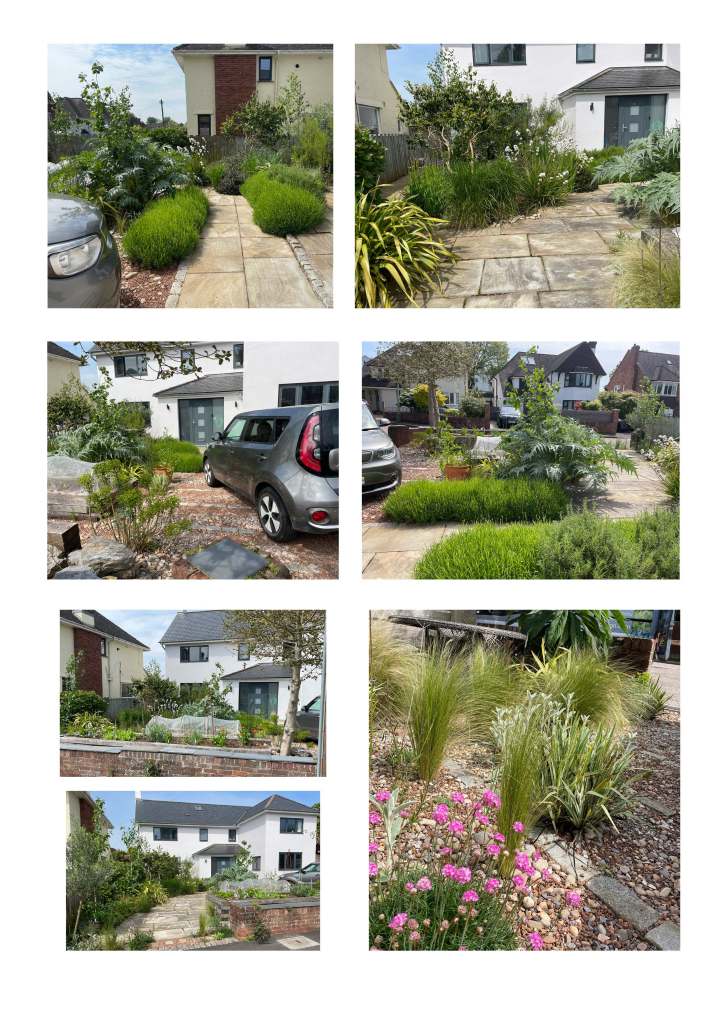
Below:
A new contemporary style front garden, St Leonard’s, Exeter. ( 2 years after project completion.)
Design work, planting plan and construction guidance by:
EGD Landscape Architecture (Exeter Garden Design)
Construction and Planting carried out by clients as small projects over one year. Activate to view larger image,
 Landscape Community Nature